
Table of Contents
- Who Counts as a Covered Entity or Business Associate?
- HIPAA Training Requirements for Employees Who Handle PHI
- HIPAA Business Associate Agreement for Couriers
- HIPAA Training Topics for Couriers: What Your Modules Must Cover
- Medical Courier Certification: What It Is and What It Is Not
- How Often Should Couriers Receive HIPAA Training?
- Documentation, Audits, and Proving Compliance
- Conclusion: Build a Repeatable Training Process, Not a One-Time Event
- Frequently Asked Questions
Last Updated: October 5, 2026
Who Counts as a Covered Entity or Business Associate?
If your courier service moves lab specimens, medical records, or prescription paperwork, you're likely asking: is HIPAA training required for couriers? Yes, in most cases, whenever the work puts you in contact with protected health information (PHI): paper records, electronic files, or labeled specimens.
This guide from ComplianceCare breaks down who must train, what the modules must cover, and how to prove it when an auditor asks.
The Legal Definition That Decides Your Obligation
The Health Insurance Portability and Accountability Act (HIPAA) sets national standards for protecting health data. It applies to two main groups.
- Covered entity: A health plan, a healthcare clearinghouse, or a healthcare provider that bills electronically. A clinic or lab is a covered entity.
- Business associate: A person or company that performs a service for a covered entity and touches PHI. A courier that transports specimens or records usually fits here.
If you're a business associate, you must follow the privacy rule and the security rule. The HHS summary of the HIPAA privacy rule spells out those duties.
A courier who only moves sealed packages with no health data inside may fall outside HIPAA.
The Conduit Exception: When a Courier Is Not a Business Associate
One narrow path exists where a courier is neither a covered entity nor a business associate: the conduit exception. It applies to an entity that transports PHI without accessing it beyond what is incidental, a courier moving a sealed, opaque tote from one locked dock to another, never opening it, reading a label, or storing it overnight.
Most medical courier work does not fit that exception. The moment a driver signs for a specimen bag, reads a patient name to confirm a handoff, or stores a package in a vehicle between stops, the work exceeds mere transmission.
Subcontractors and the Chain of Agreements
Here's the part most guides miss: a courier can also be a subcontractor to another business associate. If a dispatch software vendor, lab logistics broker, or staffing agency hires you to move PHI on its behalf, that vendor needs a BAA with you too.
An independent courier on app-based dispatch may owe duties to the platform, the platform to the lab, and the lab to the patient.
A Quick Decision Framework for Couriers
Use these questions in order. The first "yes" tells you where you stand.
- Do you sign a BAA with a covered entity or another business associate? If yes, you are a business associate or subcontractor and HIPAA training obligations attach.
- Do you see, carry, or store PHI, names, specimen labels, charts, prescription paperwork, or ePHI on a device? If yes, treat yourself as covered even if no BAA is on file yet.
- Is the package fully sealed, never opened, never labeled with patient data, and never stored? If yes, you may fit the conduit exception, but document that reasoning in writing.
- Are you an independent courier under a platform or broker? Ask who holds the BAA with the covered entity and whether you are named as a subcontractor.
State Law and Contract Terms Can Go Further
Federal HIPAA sets a floor, not a ceiling. Some states impose stricter confidentiality rules, and covered entities often write training frequency, background check, and vehicle security requirements into courier contracts, a hospital system may require annual training with a signed attestation, a reference lab quarterly refreshers and a chain-of-custody audit. Read the BAA and master service agreement together; the contract often tells you more about your actual training obligations than the statute does.
HIPAA Training Requirements for Employees Who Handle PHI
HIPAA names no specific course or certificate. It requires that your workforce be trained on your privacy and security policies, a standard enforced through the business associate agreement you sign.
In practice, every staff member who can see, carry, or access PHI needs training, drivers, dispatchers, and anyone handling delivery paperwork.
The training must be role-based. A driver needs to know how to keep a specimen bag sealed and logged.
HIPAA requires training, not a brand-name certificate. What matters is that your staff are trained on your own policies and that you can prove it.
A common mistake is treating one annual seminar as enough. New hires, route changes, and new clients all shift what your team touches. Training has to keep pace.
HIPAA Business Associate Agreement for Couriers
A business associate agreement (BAA) is a contract between a covered entity and a business associate stating how PHI will be protected, used, and returned or destroyed.
A solid BAA should cover:
- What PHI the courier will handle and why
- The safeguards the courier will use
- A promise to report any breach
A courier can also be a subcontractor to another business associate. If a dispatch software vendor hires you to move data, that vendor needs a BAA with you too, and the chain must hold at every link.
HIPAA Training Topics for Couriers: What Your Modules Must Cover
Every courier training program should cover the same core ground. Skip a topic, and you leave a gap an auditor will find.
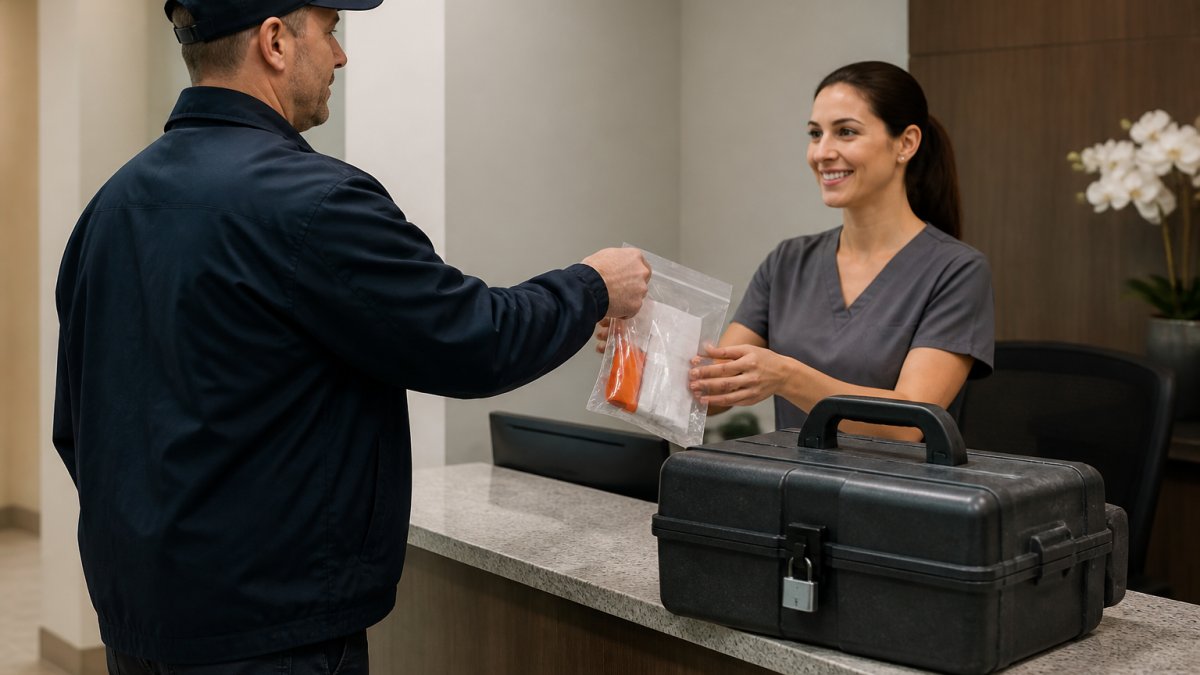
The essentials:
- What counts as PHI, and what does not
- The minimum necessary rule: share only what the job needs
- Administrative safeguards: policies, training, and access control
Secure Handling and Transport of Specimens and Records
Specimen handling and medical records transport follow the same logic: keep the item sealed, logged, and accounted for. A chain of custody log records who had the item and when, your first defense if a bag goes missing.
Incident Reporting and Breach Notification Steps
When something goes wrong, speed matters. A lost specimen bag or a misdelivered chart is a potential breach.
The steps are simple:
- Report the incident to your compliance lead the same day.
- Document what was lost, when, and who was involved.
- Assess whether the data was actually exposed.
- Notify the covered entity so it can meet its own breach notification duties.
The covered entity carries the legal duty to notify patients and, in some cases, HHS Office for Civil Rights. Your job is to report fast and document clearly.
Medical Courier Certification: What It Is and What It Is Not
Medical courier certification is a training credential, not a legal license. It shows clients you take compliance seriously, but it does not replace the training HIPAA requires.
Here's the difference that trips people up:
| Item | What It Is | What It Is Not |
|---|---|---|
| HIPAA training | Required by law for staff handling PHI | A one-time event |
| Paid certificate | A vendor-issued credential | A government license |
| BAA | A contract creating legal duty | A training record |
| Completion log | Proof your staff trained | Proof of certification |
Paid certification products can be useful. But don't confuse a certificate with compliance. What an auditor wants is a record that your people trained on your policies, on a schedule.
How Often Should Couriers Receive HIPAA Training?
HIPAA does not set a fixed training interval. The HHS guidance on HIPAA training notes that training must be ongoing, not a single event, and that it must be repeated as policies and procedures change.
For a courier business, a recurring schedule beats one long session: short, regular modules keep the rules fresh and make it easy to slot in new hires.
The Four Retraining Triggers
- Onboarding. Before the first delivery, every driver, dispatcher, and office staffer who can see PHI completes training on your written privacy and security policies. No exceptions for part-time or seasonal drivers.
- Recurring refreshers. Most courier businesses run a short module monthly or quarterly and a fuller review annually. The rhythm matters less than the record: a dated log showing who trained and when.
- Event-driven retraining. After a misdelivered package, a lost specimen bag, a stolen device, or any suspected breach, retrain the affected staff and anyone whose route or duties touch the same risk. Document the incident and the retraining together.
- Change-driven retraining. New client, new route, new dispatch software, new vehicle security protocol, or a revised BAA, each of these shifts what your team touches and how. Retrain before the change goes live, not after.
What a Practical Schedule Looks Like
A workable pattern for a small courier operation:
- Day one: onboarding module covering PHI basics, minimum necessary, and incident reporting.
- Monthly: a five-minute refresher on one topic, chain of custody, locked cases, secure messaging, or a real incident from the prior month.
- Annually: a fuller review of your written policies, plus a signed attestation from each staff member.
This is not a legal mandate. It is a defensible practice that matches what auditors and covered-entity clients expect to see when they review your program.
Documentation: What to Keep and For How Long
Documentation is where most courier businesses get caught. You can train everyone well and still fail an audit if you can't show the records. Keep these on file:
- Signed BAAs for every covered entity client and every upstream business associate
- A training log with names, dates, topics, and the trainer or module used
- Your written privacy and security policies, with version dates
There is no single federal retention period for courier training records. A common practice is to retain them at least six years from creation, aligning with the HIPAA documentation retention standard for covered entities and business associates. Some BAAs impose a longer period, so read the contract.
Why a One-Time Seminar Fails
A single annual seminar cannot keep pace with route changes, new clients, and new hires, and it produces one record that proves little. A short, recurring schedule with clear triggers produces a paper trail showing your program is live, what protects you when a specimen bag goes missing or a chart is misdelivered.
Documentation, Audits, and Proving Compliance
This is where ComplianceCare fits for small practices and courier teams. Our platform automates assignment and tracking of training modules, runs short five-minute monthly sessions, and includes a Business Associate Agreement at no extra cost.
Conclusion: Build a Repeatable Training Process, Not a One-Time Event
The real challenge isn't the first training session. It's keeping every driver, dispatcher, and new hire current as your routes and clients change.
ComplianceCare handles that for you. Automated assignment and tracking keeps everyone on schedule. Short monthly modules fit into a workday.
Start your free trial with ComplianceCare and turn HIPAA training into a process you set once and trust.
Frequently Asked Questions
Is HIPAA training required for medical couriers?
It depends on whether the courier handles protected health information on behalf of a covered entity or business associate. If a clinic, lab, or billing company hires you to transport records, specimens, or equipment that carries PHI, the HIPAA Privacy and Security Rules require that workforce to be trained. Independent couriers who never see PHI, such as a driver moving sealed boxes with no patient identifiers, fall outside that duty.
Are medical couriers considered business associates under HIPAA?
Often yes. A courier who creates, receives, maintains, or transmits PHI for a covered entity is functioning as a business associate when the work involves more than incidental contact. That relationship should be documented with a signed business associate agreement, which spells out permitted uses of PHI, safeguards, and breach reporting duties. Some couriers work as subcontractors to another business associate instead, and the same downstream obligations apply.
Do medical couriers need HIPAA certification?
HIPAA does not issue or recognize a certification. The rules require documented training, not a certificate. Paid certification products can be useful for showing completion, but they are not a legal substitute for training that matches the courier's actual duties. What matters in an audit is a dated record showing who was trained, on what topics, and when the next refresher is due.
How often should medical couriers receive HIPAA training?
The rules require training at onboarding and whenever job duties or privacy practices change. Most compliance programs add annual refreshers, and shorter recurring modules, such as five-minute monthly sessions, keep the material current without pulling drivers off routes. New hires should be trained before they touch PHI, not weeks later, and every session should be logged with a completion date.